
| Weight | 42 kg |
|---|---|
| Dimensions | 85 × 90 × 114 cm |
| Version | 60x60cm therapy surface with handrail |

Aktuell keine Variante sofort verfügbar.
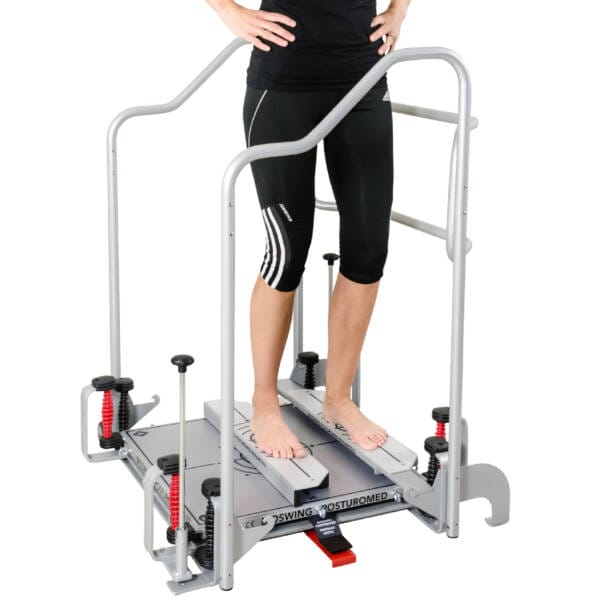
The Haider Bioswing Posturomed 202 offers a unique training experience for stabilizing and improving balance. With its highly sensitive 60x60cm swing surface, it responds to the slightest movement, actively engaging the deeper lying muscles.
This therapeutic approach enables an effective improvement in posture stability, which is especially valuable for patients in orthopedics, neurology, rehabilitation, and sports therapy.
The Posturomed 202 therapy system impresses with its individually adjustable oscillation intensity. Users can precisely tailor the difficulty of the training to their needs. Thanks to the stepless adjustment, various exercises in the field of proprioception and sensorimotor rehabilitation can be optimally designed.
Training on the Posturomed 202 is gentle on the joints and promotes neural activation of muscles.
The Posturomed 202 offers a proven platform for rehabilitation after injuries, particularly in the areas of the ankles, knees, and hips. By gently swinging the device, affected structures are cautiously loaded and simultaneously strengthened.
The targeted balance therapy supports the restoration of natural movement patterns and helps prevent improper loading. This approach leads to a faster and more sustainable healing process, reducing the risk of reinjury.
Especially individuals who sit for extended periods or are subjected to unilateral strain benefit from the preventive effects of the Posturomed. The training promotes the activation of the deep muscles, which are crucial for maintaining a stable body posture. Regular exercises on the device enhance upright posture and prevent long-term issues such as back pain or neck tension.
In both workplace health promotion and personal use, the Posturomed is a valuable addition.
Patients with neurological deficits, such as after a stroke or with multiple sclerosis, benefit from the sensorimotor stimulation of the device. The unconscious activation of muscles and improved body awareness help enhance movement coordination and balance.
The Posturomed 202 is the first and so far only dampened, unstable, pendulum-like sensorimotor therapy device that has occupied an outstanding place in therapy and prevention since its introduction in 1995. Its development, supported by decades of scientific and practical expertise in the 1980s, was carried out in close cooperation with physiotherapists and specialists in orthopedics, neurology, geriatrics, and rehabilitation.
Approved according to MDR 2017/745, it offers an innovative technology for targeted enhancement of sensorimotor abilities and demonstrably delivers valuable therapy results.
The Posturomed 202 is equipped with a three-sided safety rail that provides additional security during training. At the same time, exercises can be performed on the standing surface without completely losing balance.
This additional support is particularly helpful for beginners or individuals with limited mobility who initially require assisted training before venturing onto the unstable surface without aids.
The extensions for Posturomed offer high flexibility in therapy customization and allow the device to be precisely tailored to the individual needs of patients. The easy retrofitting capability enables the modules to be seamlessly integrated at various stages of rehabilitation, significantly expanding the applications of Posturomed.
The OSG module enhances the Posturomed with a tilting axis specifically designed to strengthen and stabilize the ankle joints. It enables the therapeutic movement impulses of the Posturomed to be utilized outside the horizontal plane. With precisely adjustable tilting, the movement can be limited to 7°, 10°, 15°, or 20° per side, both symmetrically and asymmetrically. These customization options prevent unphysiologically large movements while promoting the activation of stabilizing muscles.
Additionally, the axis can be modified by a 45° fixation on the base plate. With a standing surface of 32 cm in diameter and a robust plastic coating, the module provides reliable support in the rehabilitation of ankle injuries, aimed at improving proprioceptive abilities and reducing the risk of injury.

The rehab module, exclusively for the Posturomed 202, enables targeted stabilization exercises for the knees, hips, and pelvis. These exercises can be performed both isometrically and dynamically to activate the muscles in a closed kinetic chain.
Thanks to the partial relief of the lower extremities, the patient trains on a safe and controlled surface. One leg stands stable on a fixed point, while the other leg trains unstably on the mobile element, which is securely locked on the swinging surface.
This module is invaluable, especially in the rehabilitation phase after injuries or surgeries on these joints. It allows for gentle yet effective training that can be customized individually.
This module consists of a crossbar, push element, and mounting device, and can be optimally combined with cable machines or similar resistances that can be attached to the Posturomed.
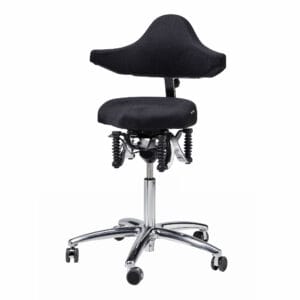
The seat module enhances the Posturomed 202 and Compact by allowing targeted stabilization exercises to be conducted while sitting. It is especially suited for patients who cannot train while standing due to injuries, surgeries, or age-related limitations. This is particularly beneficial in rehabilitation following severe injuries or surgeries.
The module provides secure support through a wipe-disinfectable, ergonomic molded seat made of medical faux leather and is infinitely adjustable in height from 38 to 51 cm to accommodate individual body sizes. Particularly in geriatrics, neurology, and orthopedics, it enables effective stabilization exercises, especially for the lumbar region, without the strain of standing.

The Provocation Module enables precise deflection of the therapy surface of the Posturomed by 10, 20, or 30 mm. This controlled lateral-medial or anterior-posterior deflection provokes a targeted muscular reaction and offers a standardized feedback training.
This module is particularly valuable for testing segmental stability and setting targeted training stimuli that enhance the patient’s adaptability. With the various levels of deflection, the module can be individually tailored to the patient’s abilities, allowing for differentiated and effective training.

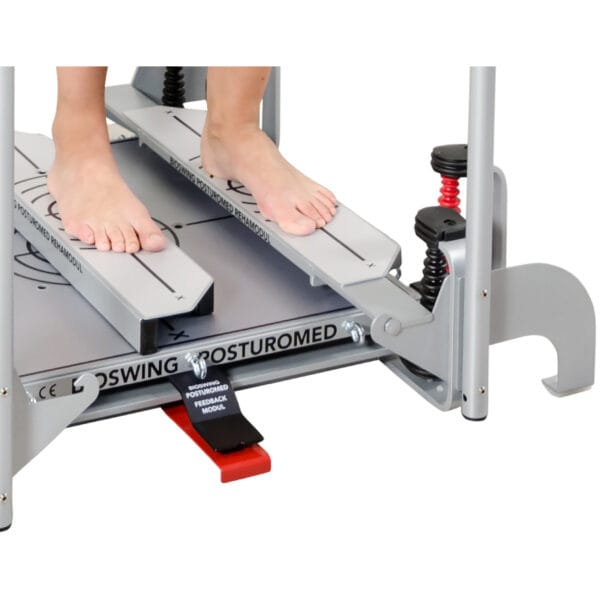
The feedback module of the Posturomed offers immediate visual feedback on the movements of the therapy surface, which is particularly valuable in combination with the rehab module. The two differently colored elements (red and black) are attached to the sides of the Posturomed 202 and Compact. It consists of three pairs for connection on three sides.
In a resting state, the elements overlap, while in the event of a movement deviation, the red elements become visible and indicate the direction of the movement. This allows both the therapist and the patient to precisely observe the quality of movement and motor control. Unwanted deviations can be immediately recognized and corrected, enabling the therapy to be adjusted precisely and effectively.
The step mat for the Posturomed 202 enables standardized and safe execution of exercises, where the starting position is in front of the device. It ensures a consistent step length, especially during stepping exercises, allowing for an accurate assessment of therapy progress. With secure locking on the steel rail, the mat remains stable, providing patients with additional orientation and safety during training.
Specifically developed for the PKT (Posturo Cybernetic Test) and comparable measurements, the mat adjusts the step length to the user’s height to ensure consistent and comparable results.
The marking mat is suitable for body lengths from 150 to 214 cm. The wipeable, disinfectable plastic surface also ensures hygienic use, ideal for therapeutic applications.

The Haider Bioswing Contact Module for the Posturomed 202 extends training with variable attachment options for elastic bands, providing patients with targeted tactile stimuli. These stimuli improve movement quality by helping to limit or indicate uncontrolled movement deviations. Additionally, the module can serve as resistance to promote the strengthening of specific movements, for example by placing the elastic band around the patient’s leg.
With the differently long elastic tubes (2x 600 mm, 2x 900 mm), which can be positioned flexibly, a customized adaptation to the respective therapy is enabled. Especially in rehabilitation after injuries or with motor disorders, the contact module contributes to improved body awareness and stability.


To ensure that your selection exactly matches your preferences, we ask you to review it once more:
These products cannot be altered or returned after purchase.





Reviews
There are no reviews yet.
Show only reviews in English ()